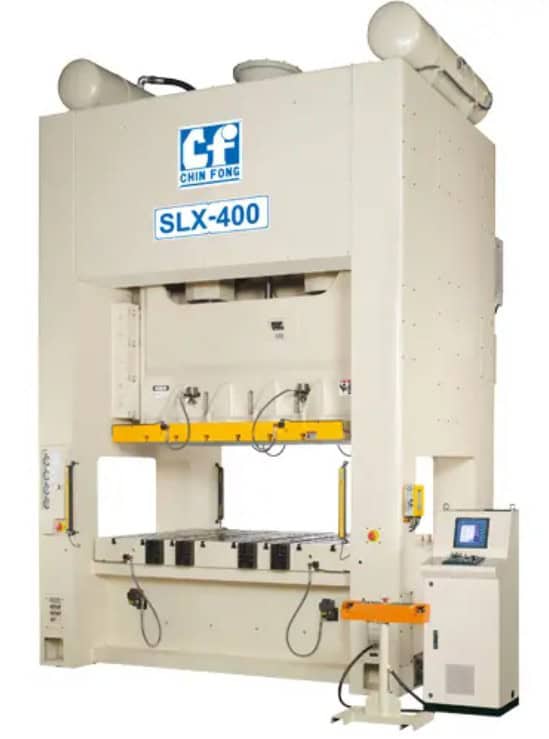
Equipment
2 × 3,000-tonne presses
Regulatory
NSW Noise Policy for industry
Compliance confirmed
Location assessed before relocation
Outcome
Validated to within 1 dB
The operation
Relocating significant industrial noise sources is a compliance commitment, not just a logistics decision. Under the NSW Noise Policy for Industry, operators need a noise assessment to confirm their new site can meet environmental noise limits before equipment moves. A Hunter Valley fabrication business faced exactly that question when preparing to relocate two Chin Fong straight-side power presses, each with a 3,000-tonne forming capacity. Running together, they represent a substantial cumulative acoustic load. Advitech assessed the compliance position in advance, developed a mitigation package, and validated the model against real operating conditions after relocation. Measured noise levels at the nearest sensitive receiver came in within 1 dB of what the model predicted.
The challenge - Predicting compliance at a new site before a single machine moved
The core technical challenge was predicting whether the presses could operate within NPfI limits at the new site before the move took place. That meant measuring the acoustic character of the presses at the existing facility, characterising the ambient environment at the new location, and modelling what cumulative emissions would look like with both machines running alongside existing site operations.
Adding genuine complexity to that picture was the M1 Hexham extension, a major freeway then under construction adjacent to the new site. The surrounding acoustic environment was not static. Any assessment based only on current conditions would be incomplete.
How a four-phase methodology produced a validated compliance position
The methodology was designed to produce a compliance position that held in real operating conditions. It did. Post-relocation monitoring confirmed model predictions to within 1 dB. The assessment was structured across four phases.
Phase 1 established the Sound Power Level (SWL) of each press under operational conditions at the existing site, including the worst-case scenario of both machines running simultaneously. This formed the technical foundation for all subsequent modelling.
Phase 2 characterised the acoustic environment at the proposed new location. Monitoring was conducted across the relevant receiver locations to establish the existing ambient baseline.
Phase 3 modelled cumulative noise from the new presses combined with existing site operations. Where predicted levels approached or exceeded NPfI limits, Advitech developed a practical set of mitigation measures: acoustic barriers, partial and full press enclosures, vibration isolation at the source, and targeted upgrades to the building shell based on its assessed sound reduction performance. For scenarios where material handling required access doorways to remain open, the team defined specific operational conditions under which those openings could be used without pushing emissions beyond the limit.
Phase 4involved attended noise monitoring across day, evening, and night periods at the new location, once the presses were relocated and operational. At the nearest noise-sensitive receiver, measured levels were within 1 dB of the model predictions. An excellent result that confirmed both the accuracy of the assessment approach and the suitability of the mitigation measures recommended in Phase 3.
How we approach it
Source measurement
Sound Power Level of each press measured at the existing site under worst-case operating conditions, including both machines running simultaneously.
Site assessment
Ambient noise monitored at the new location across all relevant receiver points, establishing the existing baseline including modelled future freeway conditions.

Modelling and mitigation
Cumulative noise modelled against NPfI limits. A practical mitigation package developed covering barriers, enclosures, vibration isolation, building upgrades, and access protocols.

Validation monitoring
Attended noise monitoring conducted post-relocation across day, evening, and night periods to confirm model predictions and verify mitigation performance.
Output
A validated compliance position, documented management controls, and a roadmap the operator can rely on as site conditions evolve.
Outcomes - The model held. Measured results came within 1 dB of predictions.
Phase 2 monitoring confirmed that existing operations at the new site were compliant with NPfI goals at all assessed receiver locations before the press contribution was added, establishing a clear and defensible baseline.
The SWL characterisation identified both presses as significant noise sources that would require mitigation. That finding arrived before any equipment was moved. The operator received a complete compliance roadmap: which controls were required, which building components needed upgrading, and under what operating conditions the site would remain within its environmental obligations.
Phase 4 monitoring confirmed the model held in real operating conditions. At the nearest noise-sensitive receiver, measured noise levels were within 1 dB of what the model predicted. The operator walked away with a validated compliance position and documented management controls they can rely on.
What does pre-relocation noise assessment actually give you?
Most acoustic assessments are designed to answer a single question: does this site comply today? That is necessary, but for operators relocating into environments where the surrounding acoustic conditions are still changing, it is not sufficient.
In this project, accounting for the future ambient noise contribution of the M1 Hexham extension was a deliberate part of the assessment methodology. A compliance position built on current conditions alone would have carried a known expiry date. By modelling the acoustic environment as it would exist once the freeway was operational, the assessment produced conclusions that remain valid beyond the immediate relocation window.
Post-relocation monitoring validated the model to within 1 dB at the nearest noise-sensitive receiver. That correlation matters because acoustic modelling is only as useful as its accuracy in practice. A prediction that close to real-world conditions gives operators something more than a compliance document. It gives them confidence in the decisions they make based on it.
If you are planning an equipment relocation or site expansion involving significant noise sources, Advitech’s acoustics team can assess your compliance position before you commit.
Contact Advitech to discuss an acoustic assessment for your project. enquiries@advitech.com.au | +61 2 4924 5400